How Long Can a Hermit Crab Survive Without a Shell?
If your hermit crab has left its shell, your first thought is probably: how long do I have before something bad happens? The short answer is not long. A hermit crab out of its shell is in real danger, and the clock starts ticking right away. But how fast things go wrong depends on where the crab is, how warm and humid the tank is, and why it left the shell in the first place. Here is what you need to know.
The Short Answer
A hermit crab can survive without a shell for a few hours to a few days at most. In a warm, humid tank (75-85 degrees, 70-80% humidity), a shell-less crab may last a day or two. In dry or cold conditions, it could die within hours. The soft back half of its body dries out fast without the shell to hold moisture in, and once the gills dry, the crab cannot breathe. There is no exact number because it depends on conditions, but every minute without a shell is a minute closer to death.
Bonus: Where Do Hermit Crab Shells Come From?
What Actually Kills a Hermit Crab Without a Shell

It is not just about being unprotected from predators. A shell does much more than most people think. Without it, a hermit crab faces several deadly problems at once:
- Drying out. This is the number one killer. A hermit crab’s soft tail stores water inside the shell to keep its gills wet. Without that water, the gills dry out and the crab slowly suffocates. In a dry room, this can happen in just a few hours.
- Temperature loss. The shell acts like a tiny warm room. Without it, the crab loses body heat much faster, especially at night when tank temperatures drop. Cold crabs cannot move, eat, or function.
- Physical damage. The soft tail has no hard covering. Any bump, scratch, or fall can injure the crab badly. Even rough substrate can scrape and damage the exposed skin.
- Stress. A hermit crab out of its shell is under extreme stress. Stress alone can kill them – it weakens their immune system and shuts down their body. A crab that has been shell-less for too long may not recover even if you give it a new shell.
- Other crabs. Tank mates may attack a naked crab. They see it as weak and may try to bite or drag it. In the wild, a shell-less crab is also easy food for birds, fish, and lizards.
Bonus: How Do Hermit Crabs Get Their Shells?
Why a Hermit Crab Leaves Its Shell
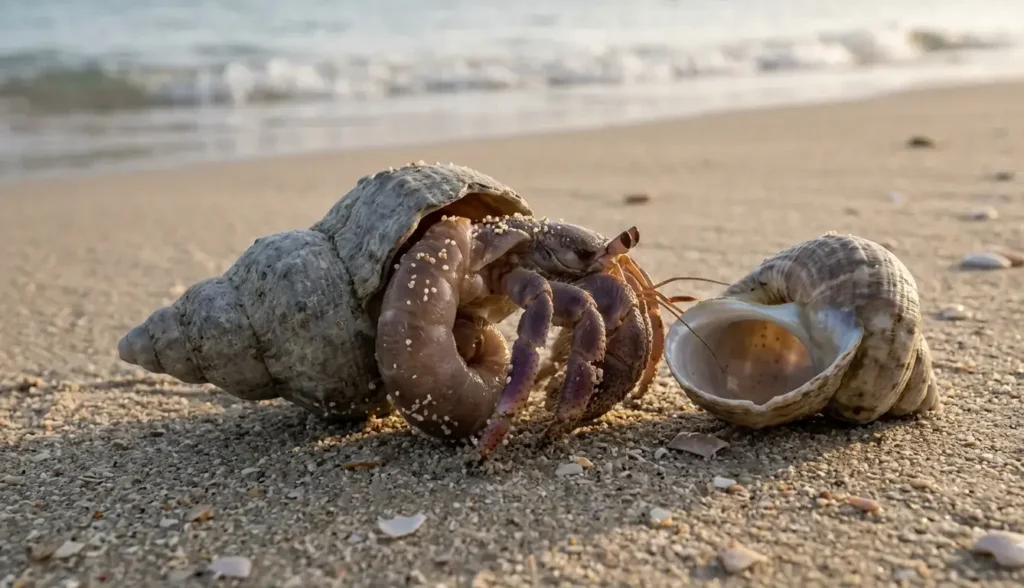
Hermit crabs do not leave their shells for fun. If your crab has come out of its shell, something is wrong. Here are the most common reasons:
- The shell does not fit anymore. After a molt, the crab may have grown too big for its current shell and needs a larger one. If no good options are available, it may sit outside waiting.
- The shell is damaged. Cracks, holes, or rough edges inside the shell can hurt the crab. If the shell is uncomfortable, it will leave.
- Too hot. If the tank is overheating – especially if a heat mat is under the tank – the shell gets hot and the crab leaves to cool down. This is an emergency.
- Wrong humidity. If humidity is too low, the crab’s gills dry out inside the shell and it panics. If it is way too high and mold is growing inside the shell, that can also force it out.
- Mites or irritants. Tiny mites living inside the shell can make it unbearable. Painted shells can also release chemicals that burn the crab’s skin over time.
- Stress or illness. A very sick or stressed crab may abandon its shell as a last-resort behavior. This is often a sign that something in the tank is seriously wrong.
What to Do If Your Hermit Crab Leaves Its Shell
Stay calm, but act fast. Here is a step-by-step plan:
- Do not touch or pick up the crab. It is already stressed. Handling it will make things worse. Leave it where it is.
- Place several shells nearby. Put 5 or more natural, unpainted shells of different sizes right next to the crab. Dip them in the tank’s salt water first to make them smell familiar.
- Check the temperature and humidity. Make sure the tank is between 75-85 degrees and humidity is 70-80%. If the tank is too hot, move the heat source. If humidity is low, mist the tank.
- Dim the lights. A dark, quiet environment helps the crab feel safe enough to pick a shell. Bright lights and noise add to the stress.
- Separate it from other crabs. If other crabs are bothering the naked crab, gently use a cup to create a barrier around it so it has space and safety to choose a shell.
- Wait. Give the crab time. Most will choose a new shell within a few hours if good options are available and conditions are right. Do not rush it.
If your crab has been out of its shell for more than 24 hours and will not go back in despite good shells and proper conditions, something deeper is wrong. At that point, it is likely very sick or badly stressed, and the chances of recovery go down fast.
Bonus: What Does a Hermit Crab Look Like Without a Shell?
Can You Force a Hermit Crab Back Into a Shell?
No. Never force a hermit crab into a shell. You can push a shell right up against the crab so it is easy to slide into, but never pick up the crab and stuff it inside. Forcing it can injure the soft body, cause extreme stress, and the crab will likely come right back out. The crab needs to choose the shell on its own. Your job is to give it good choices and the right conditions.
Conclusion:
A hermit crab without a shell is living on borrowed time – hours in bad conditions, maybe a couple of days in a warm, humid tank. If your crab has left its shell, do not panic, but do not wait either. Offer plenty of natural shells, check the tank conditions, leave the crab alone in a quiet space, and give it time to choose. The faster you act, the better the odds.
FAQs:
A: In good tank conditions, maybe 1 to 2 days. In dry or cold conditions, just a few hours. There is no safe window – every moment without a shell is dangerous.
A: No. A healthy hermit crab almost never leaves its shell fully. If yours has, something is wrong – wrong shell size, bad tank conditions, mites, or illness. Treat it as an emergency.
A: Not right away, but it is very likely to die if it stays shell-less for more than a day or two. The sooner you provide good shell options and fix the tank conditions, the better the chances of survival.