How Many Hermit Crabs Should I Get? (Don’t Start With One)
When I got my first hermit crab, I made the same mistake almost everyone makes: I bought one. Just one. The pet store employee said it would be fine on its own. It was not. That single crab sat in the corner of its tank for weeks, barely moving, barely eating. I genuinely thought something was wrong with it. Then I added two more crabs – and within 48 hours, all three were climbing, exploring, and trading shells at night like a completely different species. That experience taught me something every new owner needs to hear: the number of crabs you start with matters far more than most people realize.
What I Recommend (and Why Three Is the Magic Number)
Start with three. Not one. Not two. Three. Here is why: hermit crabs are colonial animals. In the wild, they travel in groups of 50 to 100 or more along tropical shorelines. Their entire behavioral system – shell trading, molting cues, foraging patterns, even how they regulate stress – depends on being part of a group. With just one crab, none of that kicks in. With two, you get some interaction, but one crab can dominate the other and create stress. With three, there is enough social movement that each crab can find its own rhythm – who to hang out with, who to avoid, when to explore, when to rest.
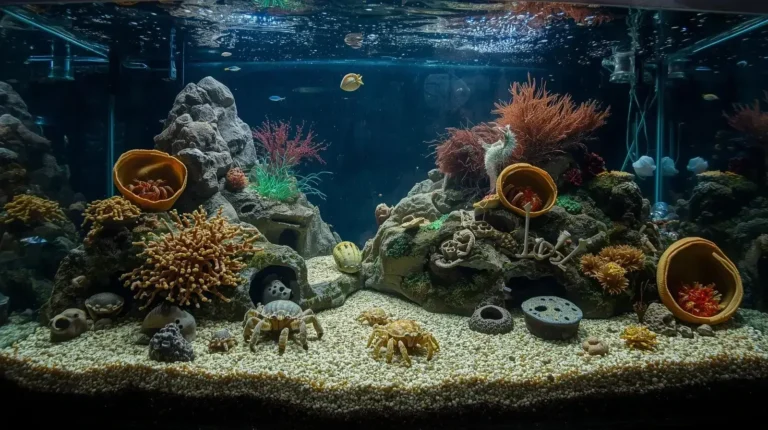
From what I have seen keeping crabs over the years, the sweet spot for most beginners is three to five crabs in a 29 to 40-gallon tank. That gives you a real colony feel without overcrowding, and it is manageable in terms of food, water changes, and shell inventory.
Bonus: How to Care for Hermit Crabs
What Actually Happens When You Keep Just One
A lone hermit crab will survive – sometimes for years – but the behavioral difference between a solo crab and a group of three is dramatic. Owners of single crabs often report the same things: the crab hides all day and all night, does not eat much, does not change shells even when better options are available, and generally seems lifeless. Many people assume hermit crabs are just boring pets. They are not. They are bored pets. There is a difference.
I have talked to owners who added a second and third crab after months of keeping a single one, and almost every time the original crab “came alive” within a few days. It started eating more, moving more, and interacting with the new arrivals. Shell swaps started happening. Nighttime activity picked up. The crab was not broken – it was lonely.
Bonus: What Do Hermit Crabs Need in Their Tank?
The Different-Sizes Trick Nobody Tells You
This is something I wish I had known earlier, and it is rarely mentioned in beginner guides. If you buy three crabs that are all roughly the same size, they will all want the same size shells. That is a recipe for shell fights – where one crab forcibly yanks another out of its shell to steal it. Shell fights are stressful, can cause lost limbs, and in the worst case, a crab left without a shell can die within hours.
The fix is simple: buy crabs of different sizes. One small, one medium, one a bit larger. They will each want different shells, which eliminates the main source of conflict. It also makes the tank more visually interesting and gives you a wider range of behaviors to observe, since crabs at different growth stages act differently.
How Many Crabs Per Tank Size?
The widely accepted guideline is about 10 gallons per crab. But I want to be honest: a 10-gallon tank with two crabs feels cramped once you add substrate, water dishes, food, shells, and hiding spots. In my experience, a 20-gallon is the real starting point and a 29-gallon is where things get comfortable.
| Tank Size | Comfortable Count | Max (Not Ideal) | My Take |
| 10 gallon | 2 small | 3 tiny | Starter only |
| 20 gallon | 2-3 | 4 small | Good first real tank |
| 29 gallon | 3-4 | 5 small | The sweet spot |
| 40 gallon | 4-5 | 6-7 small | Room to grow into |
| 55+ gallon | 5-8 | 8-10+ | Colony feel |
The “My Take” column reflects what I have actually seen work well. The numbers on paper look generous until you factor in six inches of substrate eating up half your tank’s volume, plus water dishes, shells, climbing structures, and hiding spots. Always plan for the crabs’ future size, not their current size – they grow slowly but steadily for their entire lives.
How to Tell If Your Group Size Is Wrong
After keeping crabs for a while, you develop an eye for when something is off. Here are the patterns I have noticed:
Too crowded:
- Frequent shell fights – not just inspecting each other’s shells, but actual aggressive evictions.
- Crabs climbing on top of each other nonstop – this is not cuddling, it is overcrowding.
- Molting crabs getting dug up – the most dangerous sign. Means there is not enough underground room.
- Limb loss or dropped legs – a stress response that signals something is seriously wrong.
Too few:
- A crab that never comes out, even at night when it should be exploring.
- No shell trading at all – healthy groups swap shells regularly.
- The tank feels dead – if you are checking on your crabs and nothing has moved in days, something is off.
Bonus: What Can Live with Hermit Crabs?
You Don’t Have to Buy Them All at Once
One thing I always tell new owners: start with three and add more when you are ready. There is no rush. When introducing a new crab, give it a quick dip in the tank’s salt water pool to wash off pet store grime and help it pick up the colony’s scent. Then place it in the tank at night while the others are already active. I have found this reduces the initial “who is this stranger” tension significantly. Within a day or two, the new crab will find its spot and settle in.
A Quick Note on Mixing Species
Caribbean (Purple Pincher), Ecuadorian, Strawberry, and other Coenobita species can all live together safely. I have kept Caribbeans and Ecuadorians in the same tank without any issues. The only thing to watch is temperature – Ecuadorians prefer it a bit warmer (80-85°F) than Caribbeans (75-85°F). Keeping the tank around 80°F splits the difference nicely. Different species also have slightly different shell preferences, which actually reduces competition.
Conclusion:
Start with three crabs in different sizes, give them at least 10 gallons each, and watch what happens. The difference between a lonely crab and a small colony is night and day – literally. These animals come alive after dark when they have companions to interact with. If your hermit crab seems boring, it is probably just missing its people
FAQs:
A: Better than one, but three is where the real colony behavior starts. If you can only do two right now, that is fine – just plan to add a third when you can.
A: Absolutely, if you have the space. Ten crabs need at least a 75 to 100-gallon tank. Larger groups actually behave more naturally – you will see proper shell swap chains, group foraging, and cluster sleeping.
A: Rarely, if the tank has enough space, food, and shells. Most “fighting” is actually shell negotiation – they tap and inspect each other’s shells, which looks aggressive but is normal. Real fights usually mean overcrowding or not enough shell options.


One Comment