How Do Hermit Crabs Breed and Reproduce? (Simple Guide)
How do hermit crabs breed? It turns out that these small creatures have a surprisingly complex process for making babies. Unlike many pets, hermit crabs cannot complete their entire breeding cycle on land. They depend on the ocean — or at least saltwater — for the earliest stages of their babies’ lives. This guide walks you through the full process in plain language, from courtship to baby crabs walking on land.
How Do Hermit Crabs Mate?
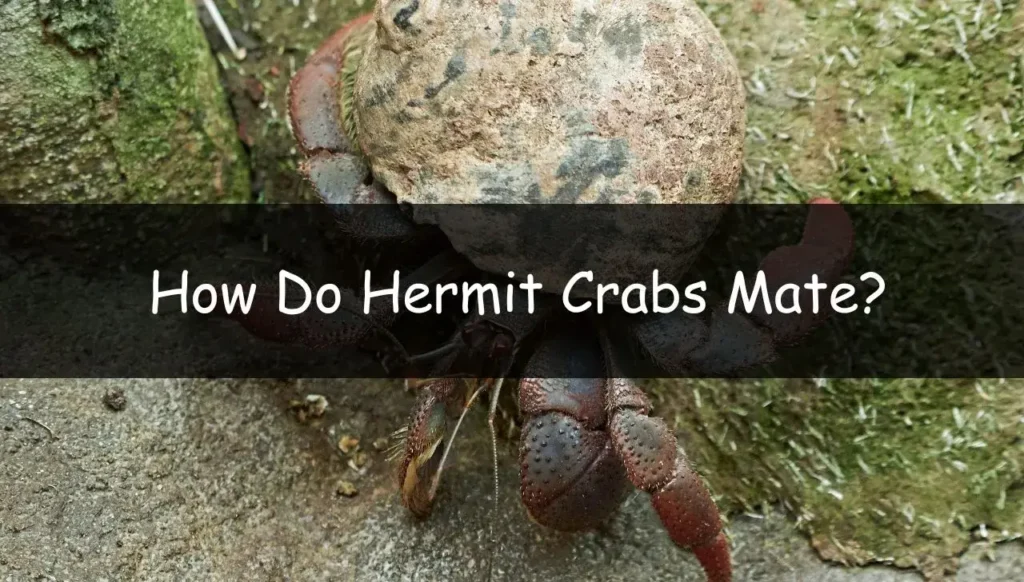
Hermit crab mating starts with the female. When she is ready to breed — usually right before she sheds her outer skin — she releases a special scent (called a pheromone) that nearby males can detect. Males that pick up the scent will approach and compete with each other for the chance to mate. The strongest or most persistent male typically wins, but the final decision belongs to the female(Happy Hermie, 2023).
The male courts the female by gently tapping or rocking her shell. If she is interested, both crabs partially come out of their shells and the male passes a packet of sperm to the female. The whole process happens quickly and usually at night (Hermit-Crab.com, 2023). In the wild, this often happens during mass gatherings near the shoreline, where dozens or even hundreds of crabs come together during breeding season, which typically runs from late spring through summer (Land Hermit Crab Captive Breeding Projects, n.d.).
Bonus: Why Do Hermit Crabs Need Shells?
What Happens After Mating?
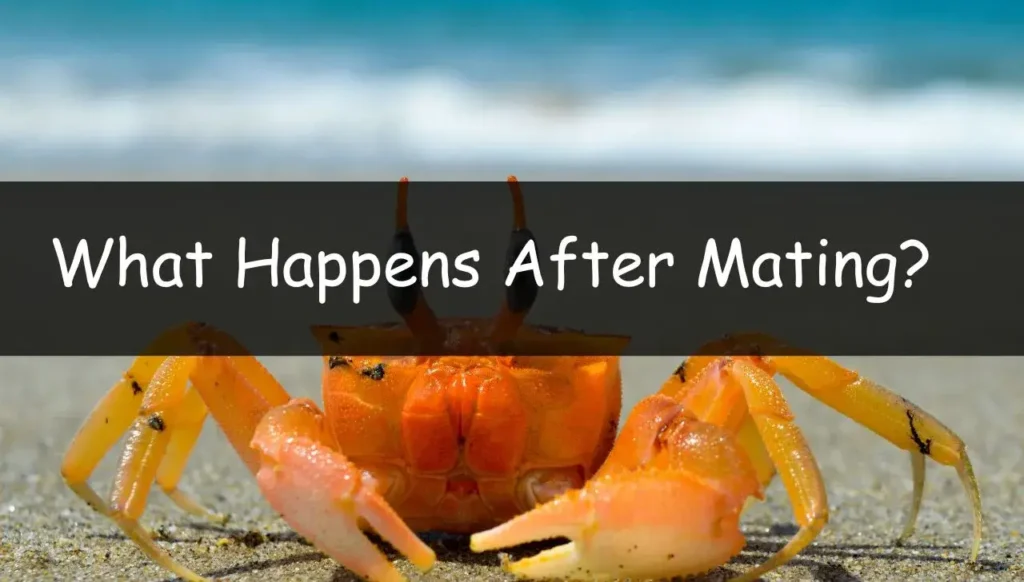
After mating, the female lays her fertilized eggs and tucks them against the left side of her body, inside her shell. She holds them in place using small, feathery limbs on her belly. A single female can carry anywhere from several hundred to thousands of eggs at a time (Happy Hermie, 2023). The eggs start out bright pink or red, gradually fade to pale pink, and finally turn see-through when the babies are nearly ready to hatch — a process that takes about four weeks (Happy Hermie, 2023).
When the eggs are ready, the female travels to the ocean (or, in captivity, a pool of marine saltwater) and releases them into the water. The moment the eggs touch saltwater, they burst open, and tiny swimming larvae come out. These newly hatched babies are called zoea — and they look nothing like crabs. They are tiny, almost invisible to the eye, and resemble miniature shrimp (Berry Patch Farms, 2024).
How Are Hermit Crabs Born and How Do They Grow?
Baby hermit crabs go through several stages before they become the shell-carrying crabs we recognize. After hatching as zoea, they float in the water and feed on tiny organisms while shedding their outer layer multiple times. This floating stage lasts roughly 30 to 60 days, depending on the species and water temperature (ReptiChip, 2023).
After the zoea stage, they enter what is called the megalopa stage, where they start to look more like actual crabs. At this point, the young crab sinks to the bottom, finds its very first tiny shell, crawls inside, and begins leaving the water. It then burrows into sand to shed its skin one final time and emerges as a true land-dwelling hermit crab (Land Hermit Crab Captive Breeding Projects, n.d.). The whole journey — from egg to a baby crab walking on land — takes roughly two to four months.
Can You Breed Hermit Crabs at Home?
Technically, yes — but it is extremely difficult. Hermit crabs will sometimes mate in captivity if the conditions are right: proper temperature (around 82°F), high humidity, and a calm environment. But the real challenge begins after the eggs hatch. The baby zoea needs carefully controlled saltwater, tiny live food, and round-the-clock feeding for weeks (The Crab Street Journal, 2025).
Very few people have ever managed to raise hermit crab babies to the land-dwelling stage at home. The most successful is Mary Akers, a hobbyist from New York, who brought over 200 babies to land in 2018 and over 700 in 2019. Dr. Christopher Tudge, a reproductive biology researcher at American University, called her work impressive, noting that even scientists in labs have struggled with this (The Outline, 2019). Akers went on to found Hermit House, a nonprofit dedicated to protecting wild hermit crabs (Land Hermit Crab Captive Breeding Projects, n.d.).
The bottom line: while your pet hermit crabs may mate and even produce eggs, raising those eggs into baby crabs requires serious time, equipment, and dedication. It is not something that happens by accident in a tank.
Bonus: How Long Do Hermit Crabs Live?
Conclusion
Hermit crab reproduction is fascinating, from females carrying eggs to tiny larvae finding their first shells. Understanding their breeding highlights how complex and remarkable these small creatures are, even though breeding them at home is challenging.
FAQs:
Q1: Do hermit crabs lay eggs?
A: Yes. Females carry fertilized eggs in their shells for about a month and release them into saltwater, where they hatch into tiny swimming larvae.
Q2: How can you tell if a hermit crab is male or female?
A: Females have small openings near their back legs and feathery limbs to hold eggs. Males don’t have these and usually have hairier legs.
Q3: When can hermit crabs breed?
A: They show mating behavior around 2 years old. Females can produce eggs in about 3 years.