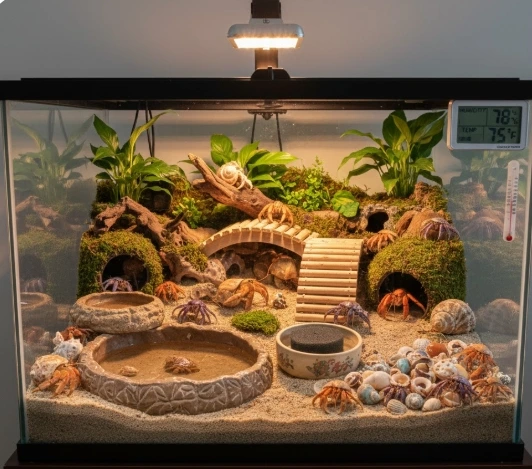
How Big Should a Hermit Crab Tank Be? Tank Size, Space & Setup Guide
Hermit crabs need at least 5 gallons of space per crab. A 10-gallon tank is the realistic minimum to start, even for one or two small crabs.
Bigger tanks hold humidity better and allow the deep substrate crabs need for molting. A tank that is too small leads to poor molting, stress, and aggression.
How Much Space Does a Hermit Crab Need?
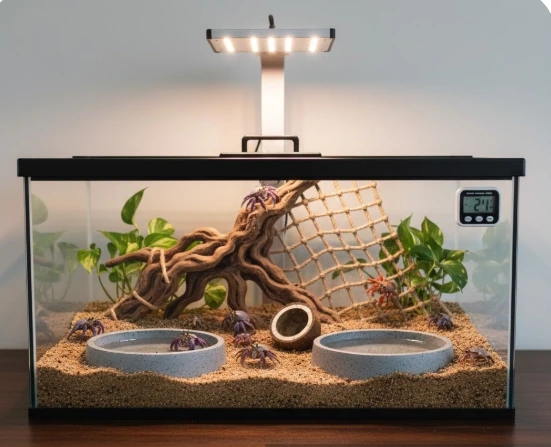
The general rule is 5 gallons per crab for small to medium crabs. More is always better.
Hermit crabs climb, burrow, and roam at night. They need at least 6 inches of substrate to molt safely.
Cramped tanks cause poor molting, stunted growth, stress, and fighting over shells.
Crabs are social and should live in groups of at least 3. Plan for a small colony, not a single crab.
Jumbo crabs need far more than 5 gallons. One with a leg span over 3 inches needs closer to 15 gallons and 10 to 12 inches of substrate.
Hermit Crab Tank Size Chart:
| Tank size | Number of crabs | Best for |
|---|---|---|
| 5 gallon | 1 tiny crab | Short-term only, not ideal |
| 10 gallon | 1 to 2 small crabs | Good starter tank |
| 20 gallon | 2 to 4 small or medium | Recommended for most owners |
| 40 gallon | 4 to 6 crabs | Great for a thriving colony |
| 55+ gallon | 6+ or large crabs | Long-term and jumbo crabs |
Most owners do best with a 20-gallon tank. It fits a healthy group and holds humidity well.
Why Bigger Tanks Are Easier:
A bigger tank is usually easier to live with, once it is set up right.
Larger tanks resist rapid swings. Small tanks lose or gain humidity and temperature fast, and that stresses crabs.
There is a catch. A much bigger tank needs more misting, a stronger heater, and larger water dishes to hold 70 percent humidity.
Keepers who upgrade without adding those often find humidity drops, not rises.
Deep substrate, a sealed lid, and wide water dishes are what make a bigger tank easier, not size alone.
A bigger tank also fits 6 inches or more of substrate, plus room for food, water, and climbing. More space means fewer fights over shells.
If you are choosing between two sizes, go bigger, and provision it properly from day one.
Setting Up a Hermit Crab Tank:
Once you have the right size, set it up properly.
- Use glass with a tight lid. Glass holds humidity. A sealed lid keeps it in. Skip wire or mesh tops.
- Add deep substrate. At least 6 inches of play sand and coconut fiber, roughly a 5 to 1 ratio.
- Provide two water dishes. One dechlorinated fresh, one marine salt, both deep enough to submerge in.
- Install a heat mat and gauges. Mount it on the back wall, run it through a thermostat.
- Add shells, hides, and climbers. Keep 3 to 5 spare shells per crab, plus driftwood and hiding spots.
- Keep a small isolation bin ready. A 5-gallon tub with damp substrate, for a molted crab that needs safety.
- Hold the right conditions. Temperature 75 to 85°F, humidity above 70 percent, ideally 75 to 85.
Conclusion:
Hermit crabs need 5 gallons per crab minimum, 10 gallons as a realistic start, and 20 gallons as the sweet spot.
Jumbo crabs need closer to 15 gallons each. Bigger tanks hold humidity better and cut down on stress and fighting.
Pair the right size with deep substrate, two water dishes, steady heat, and plenty of shells.
(FAQs):
A: Yes, for 2 small crabs. As they grow, upgrade to 20 gallons for steadier humidity.
A: At least 3. Make sure the tank fits enough spare shells and hiding spots for everyone.
A: Sand, not rocks. Gravel and rocks block digging and can injure them.
A: Roughly 15 gallons and 10 to 12 inches of substrate, well beyond the 5 gallon rule for smaller crabs.
https://shorturl.fm/YqFDm
https://shorturl.fm/mA9gR
https://shorturl.fm/QDbco
https://shorturl.fm/8TtpK
https://shorturl.fm/NCL7y
https://shorturl.fm/6V0u1
https://shorturl.fm/vE5cc