How to Tell Hermit Crab Gender (Male vs Female)
Can you tell if your hermit crab is a boy or a girl? Yes, you can – but not the way most people think. You cannot tell by the size of the claws. You cannot tell by color. You cannot tell by how big the crab is or which shell it chose. Most of the methods you will find online are myths. There is really only one sure way to tell, and it involves looking for a very small body part that only female crabs have. Here is exactly what to look for and how to check safely.
The Only Sure Way: Look for Gonopores
The one reliable way to tell a hermit crab’s gender is by looking for gonopores – two tiny round dots on the underside of the crab’s body. Female hermit crabs have them. Males do not. That is it. If you see two small dark circles at the base of the back pair of walking legs (the legs closest to the shell), your crab is female. If there are no dots there, your crab is male.
Gonopores are the openings where the female releases her eggs during breeding. They are small – about the size of a pinhead on most pet-sized crabs – and dark in color, usually brown or black. They sit right where the last pair of walking legs meets the body, one on each side.
Bonus: How Do Hermit Crabs Breed and Reproduce?
How to Check Your Crab Safely
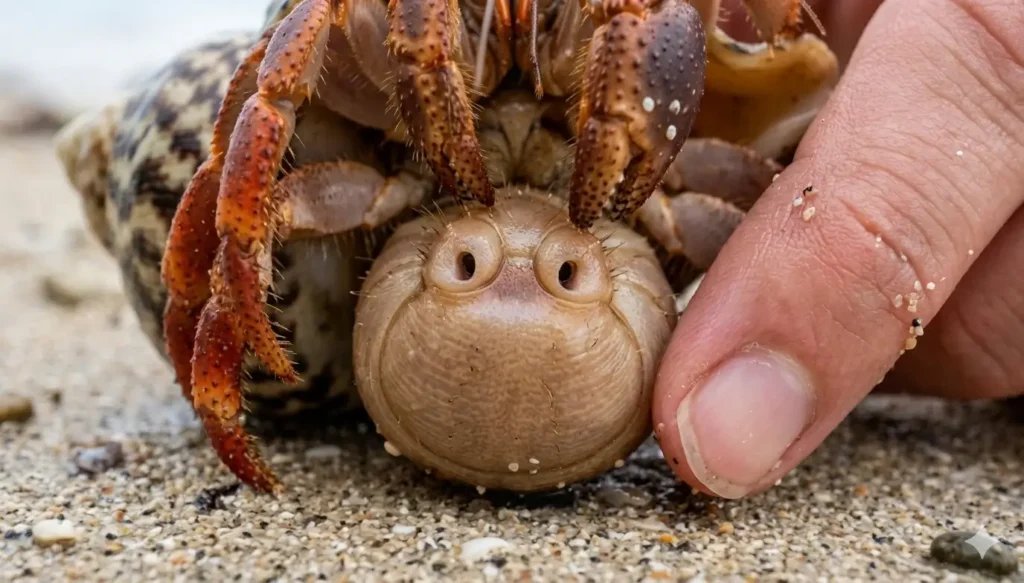
Checking your crab’s gender takes a little patience. Here are a few safe ways to do it:
- Wait for it to climb the glass. When your crab climbs the side of the tank, you can look at its underside through the glass. This is the easiest method because you do not have to touch the crab at all. Use a flashlight if needed.
- Place it in a clear glass bowl. Gently lift the crab by the shell and set it in a clear glass bowl. When the crab starts walking, look at its underside from below. The gonopores should be visible near the back walking legs.
- Hold it by the shell and wait. Pick up the crab by the back of the shell only – never by its legs or body. Hold it so the opening faces you and wait for the crab to come out a little. Use a flashlight to look at the base of the back walking legs.
- Watch during a shell change. If you are lucky enough to catch your crab switching shells, you will have a clear view of its entire body for a few seconds. This is the best chance to see both gonopores and the feathery pleopods that only females have on their belly.
Important: never force a crab out of its shell to check its gender. A hermit crab will let itself be torn apart before it lets go of its shell. Forcing it out can injure or kill it. If you cannot see the gonopores, just wait and try again another time.
The Other Female Sign: Pleopods
Female hermit crabs also have small feathery parts on the left side of their belly called pleopods. These look like tiny hairy legs or fringed flaps. The female uses them to hold eggs inside her shell until they are ready to be released into salt water. Males either do not have pleopods at all, or have very small, basic ones. The problem is, pleopods are hidden inside the shell and you can only really see them during a shell change. So while they are a helpful sign, gonopores are the easier thing to check.
Bonus: How to Breed Hermit Crabs
Myths That Do NOT Work
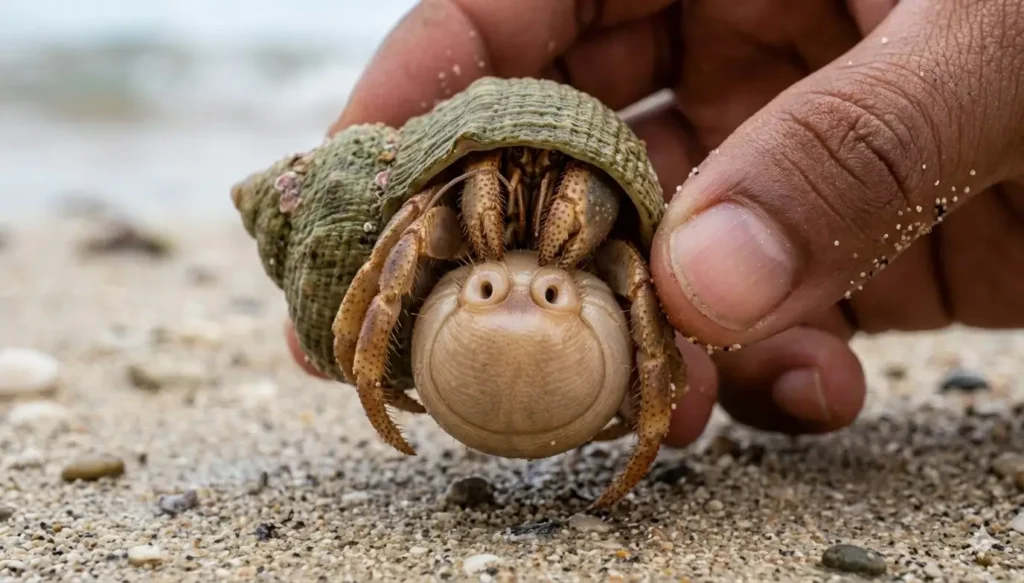
There is a lot of wrong information online about how to tell hermit crab gender. Here are the most common myths:
- Claw size does not tell you gender. Both males and females can have big or small claws. Claw size depends on species and age, not gender.
- Color does not tell you gender. Males and females come in the same colors. There are no pink-for-girls, blue-for-boys with hermit crabs.
- Body size does not tell you gender. Males tend to grow a little faster in some species, but there is too much overlap to use size as a reliable sign.
- Hairiness does not tell you gender. Both males and females have hairy legs, especially right after a molt. The myth that males are hairier is false.
- Shell choice does not tell you gender. Males and females pick shells based on fit and comfort, not gender. There is no male shell or female shell.
Does Gender Matter for Pet Owners?
Honestly? Not much. Male and female hermit crabs need the same care, eat the same food, live in the same tanks, and behave the same way. You do not need to separate them by gender. They will not fight based on gender. The only time gender matters is if you are trying to breed hermit crabs, which is an extremely advanced project that very few people attempt. For everyday pet owners, knowing the gender is more of a fun fact than a care requirement.
Can They Breed in Your Tank?
Hermit crabs can mate in a home tank if you have both males and females. The female may even carry eggs. But raising those eggs into baby crabs is almost impossible without special equipment. The babies hatch as tiny swimming larvae that need to live in salt water for weeks before they can come to land. Without a special tank setup and constant feeding, the larvae will not survive. So while mating can happen, do not expect baby crabs to show up in your tank on their own.
Frequently Asked Questions
A: Two tiny round dots, dark brown or black, at the base of the back pair of walking legs. They are about the size of a pinhead. Only females have them.
A: Yes. Wait until the crab climbs the tank glass and look at its underside from outside the tank. A flashlight helps. This is the least stressful way to check.
A: No. Males and females live together just fine, but you do not need both. There is no care difference between the two. They will be happy regardless of the mix.